
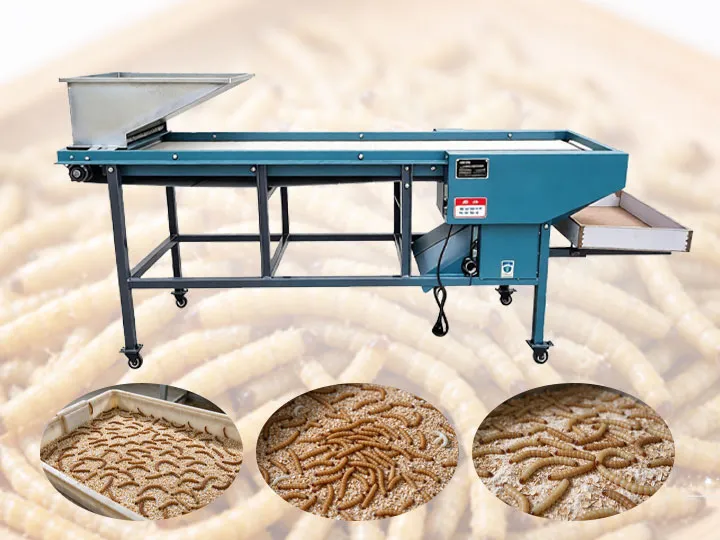
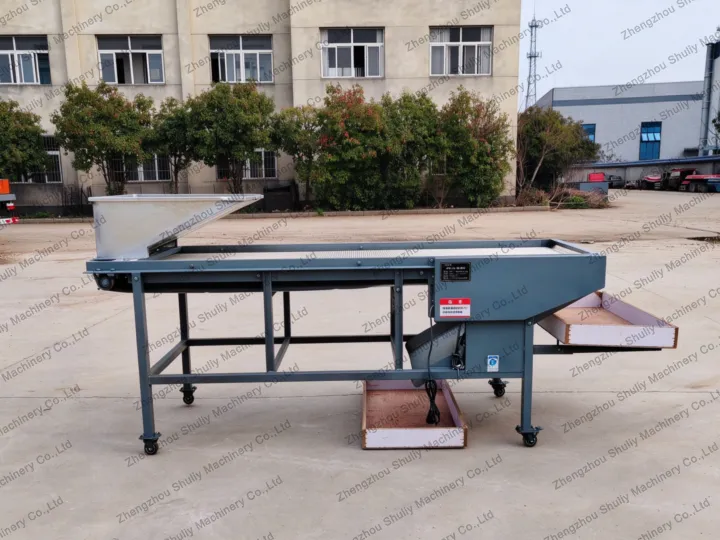
Shuliy’s 노란색 갈색거저리 선별기 is built for exactly one task: taking dead worms out of your live stock. Each unit ships as a standalone Model TZ-BS01 — 0.25 kW, 60–100 kg/h, 72 kg net weight; run as a pair on 220V 50Hz the two units draw 0.5 kW total across a combined footprint of 370 × 72 × 98 cm, screening roughly 400 jin — about 200 kg — of fresh mealworms per hour. It is deliberately a single-function machine, not a grading line: it does not sort worms by size, and it never pretends to. The equipment is exactly why it suits small and medium-sized commercial farms.
Technical Parameters of Yellow Mealworm Screening Machine
| 모델 | TZ-BS01 |
| 용량 | 60–100 kg/h |
| 전압 | 230V 50Hz, single-phase |
| 힘 | 0.25 kW |
| External dimensions | 1930 × 730 × 670 mm |
| 무게 | 72 kg |
Why A Dead-Worm Sort Deserves Its Own Machine
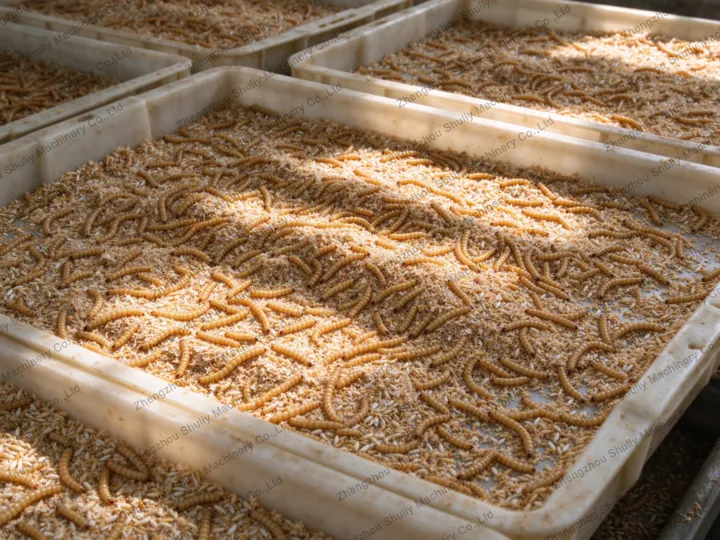
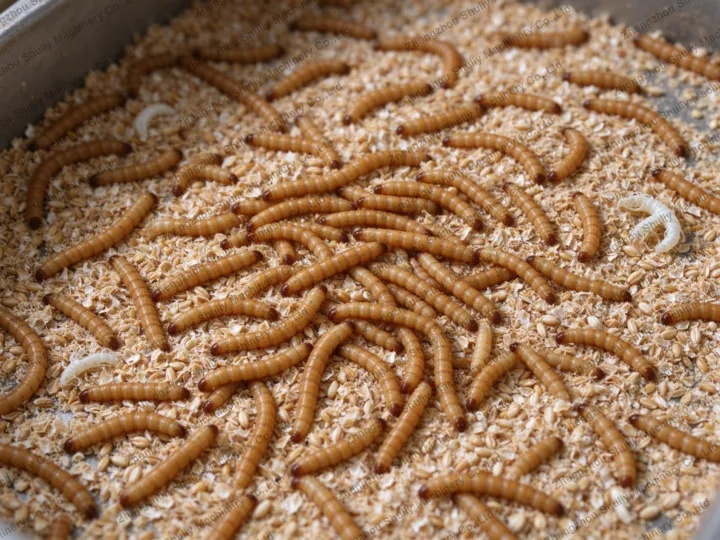
Dead larvae left in a rearing box do not simply disappear. They hold moisture against the substrate, they become a bacterial and mite food source, and they contaminate neighbouring live stock while staff are still counting them as yield. By the time a mixed lot reaches drying or sale, those dead worms have already cost feed conversion, hygiene and buyer confidence.
Most farms still handle this by hand — picking dead worms out of trays one by one — which is slow, inconsistent, and worst of all, done by tired eyes late in a shift.
This is the gap the machine fills. Because it has only one job, the screening surface and the drop-out points are tuned purely for the live-versus-dead difference in movement and weight — not shared with size grading or pupa separation. That is what keeps the power draw at 0.5 kW and the operation simple enough for one worker to load, watch and bag.
Two Popular Configuration Options for Yellow Mealworm Screening Machine
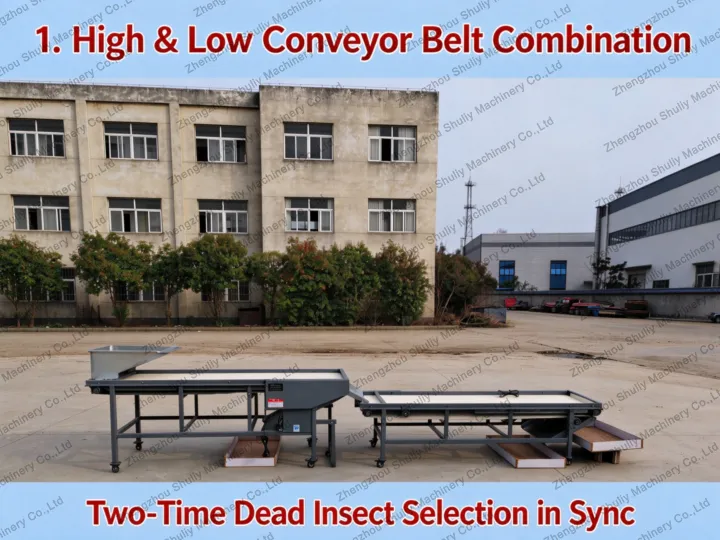
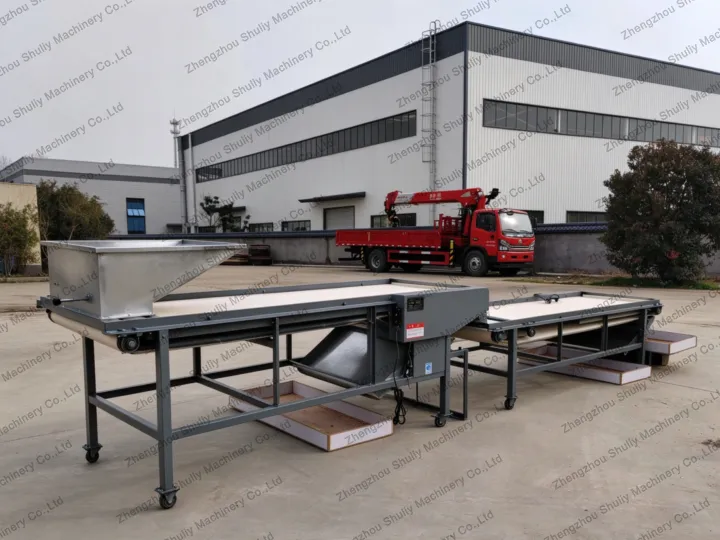
Collocation 1: Marketable Insect Screening Machine + Beetle Sorting Machine
Synchronized secondary sort.
The unit runs a second live/dead pass over about 400 jin (200 kg) of fresh worms per hour. Note the operating rule: the short unit can also sort beetles, but not at the same time as fresh-worm screening — one material, one mode, per run.
Combination Parameters
- Output: 200 kg/h (400 jin/h) for fresh worms
- 전압: 220 v / 50 hz
- Total Power: 0.5 kW
- External dimensions when assembled: 370 × 72 × 98 cm
- Taller unit: 190 × 72 × 98 cm
- Shorter unit: 190 × 72 × 55 cm
Collocation 2: Frass-Insect Separator + Marketable Insect Screening Machine
One integrated pass.
Linked to our mealworm frass sifting machine, the line completes frass sieving, skin removal, dust extraction and the secondary dead-worm sort synchronously. Size grading is the one step it cannot run simultaneously — a deliberate trade-off that keeps the setup affordable and compact for small and medium breeding bases.
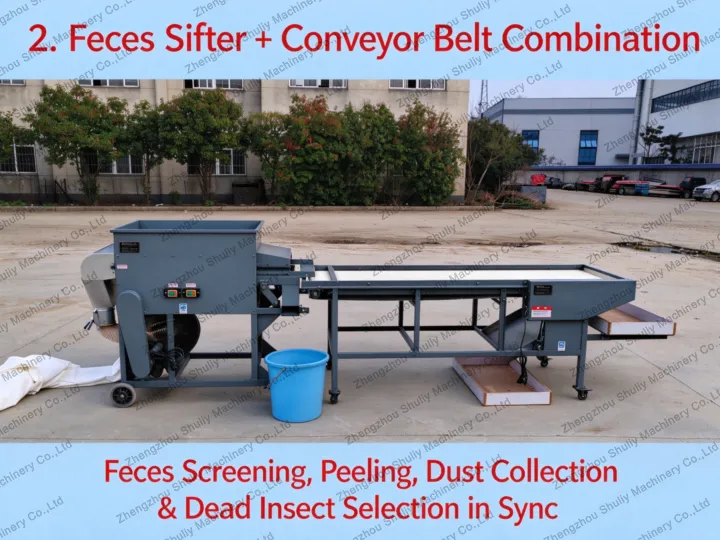
Fence Sifter Parameters
- Output: approx. 300–400 kg/hour (600–800 jin/hour)
- 힘: 1.3 kW
- 무게: 120 kg
- Dimensions: 130 × 64 × 104 cm
- 기능: Manure screening, husk/debris removal, and dust extraction
Mealworm Sorting Machine Features
- 2.2 mm thick dedicated sorting belt. The belt is the wear part of any live/dead sorter, so ours is 2.2 mm thick and tensile-resistant—it maintains tension and tracking under continuous duty instead of stretching after a few months.
- Dedicated variable-speed motor. Adjust screening speed to the actual condition of each batch—wetter, stickier frass or unusually active worms—and compensate at the dial rather than by changing belts or tooling.
- Soft-bristle brush, zero worm damage. A dedicated soft brush sweeps the worms off the belt without cutting, crushing or abrading the cuticle — live worms go back to the trays unharmed, which matters when the survivors are the product.
- Original damage-free shaking mechanism with adjustable stroke. The shaking motion that walks worms along the belt is designed to be non-damaging, and the shake distance adjusts up and down so you can set the agitation to the life stage and fill level you are running.
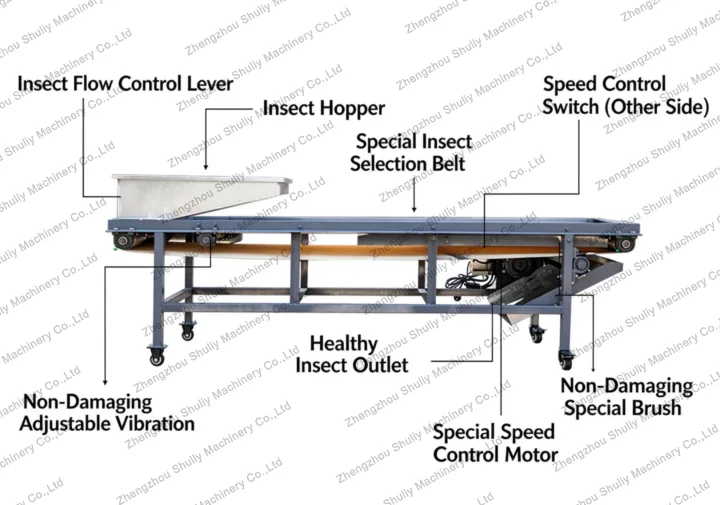
Four Ways to Run The Yellow Mealworm Screening Machine
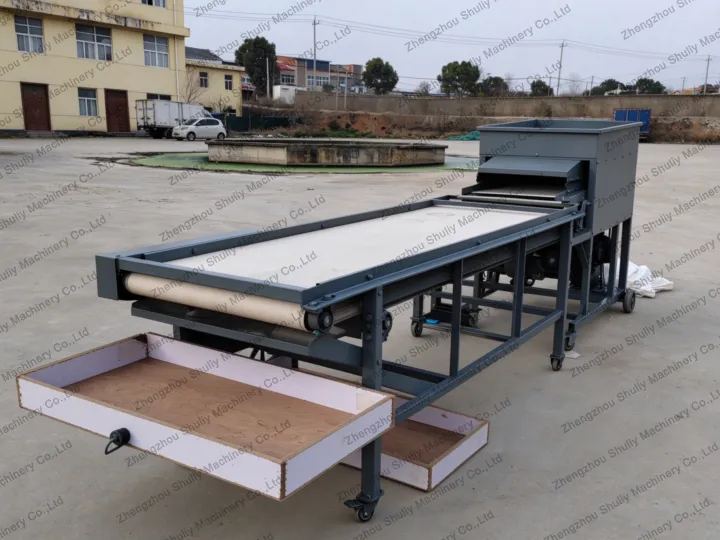
- Tall unit alone — 노란색 밀웜. Fresh larvae go in; live worms and dead worms come out separately. This is the standard small-farm configuration.
- Short unit alone — adult beetles. The same single-function sort is applied to the breeding adults, so dead beetles do not sit in the brood trays breaking down.
- Both units together — synchronized secondary sort. The unit runs a second live/dead pass over about 400 jin (200 kg) of fresh worms per hour. Note the operating rule: the short unit can also sort beetles, but not at the same time as fresh-worm screening — one material, one mode, per run.
- Paired with the frass sifter — one integrated pass. Linked to our mealworm frass sifting machine, the line completes frass sieving, skin removal, dust extraction and the secondary dead-worm sort synchronously. Size grading is the one step it cannot run simultaneously — a deliberate trade-off that keeps the setup affordable and compact for small and medium breeding bases.
Who This Machine Is For — and Who Should Choose Something Else
- Fit: small and medium commercial mealworm bases that need dead worms removed promptly and consistently, and that already grade size by hand or with a separate sifter.
- Fit: farms running breeding beetles as well as larvae, where both life stages need a live/dead pass and only one machine type is wanted for both.
- Fit: operators pairing it with a frass sifter to consolidate sieving, de-skinning, dust control and the second dead-worm sort into one run.
- Not a fit: farms that want pupa/larva separation, three-size grading and dead-worm sorting in a single machine — that is the job of the multi-stage separators such as the live & dead mealworms sorting machine with pupa and frass outlets, or the full-size SL-series new-type mealworm sifter with pupa sorting.
Where the Yellow Mealworm Screening Machine sits in The Line
The screening machine is a mid-process step: rearing trays → live/dead screening → optional size grading or frass sieving → microwave drying for processed output. Keeping the dead-worm pass upstream protects both the surviving stock in your trays and the quality of whatever goes into the dryer afterwards.
Operating Requirements and Monthly Maintenance
At a rated 60–80 rearing boxes per hour, the machine is limited by how evenly you feed it, not by the motor. Four operating rules from the manufacturer keep the sorting result at spec:
- Keep the ambient temperature at or above 25°C. The yellow mealworm screening machine is specified for use in an environment no lower than 25°C — this matches the rearing room conditions of an active mealworm base, and running it in a cold shed changes both worm movement and sorting behaviour.
- Place it on level ground. Place the machine on a flat floor; if the floor is uneven, level it. An out-of-level machine vibrates excessively during the shake cycle, which upsets both the belt tracking and the live/dead separation.
- Do not overload the feed rate. During sorting, the worm feed volume must not be turned up too high — worms need to spread evenly across the belt surface. A piled or surging mat of worms prevents the belt and brush from doing their job and directly degrades sorting accuracy.
- Maintain it monthly. Once a month: lubricate moving parts, re-tighten any loosened screws, check the conveyor belt for tracking drift (running off-centre), and ensure the chain hasn’t gone slack. Five minutes of this routine is what keeps the 2.2 mm belt and shake mechanism on specification.
FAQ of Yellow Mealworm Screening Machine
What does a yellow mealworm screening machine actually do?
It separates live mealworms from dead mealworms. It only has this one function.
Can I use the short unit for beetles and the tall unit for worms at the same time?
No. The short unit can sort adult beetles, but not while fresh-worm screening is running — each run handles one material in one mode. Run beetles in a separate pass, or dedicate the short unit to adults and the tall unit to larvae.
Can this machine grade mealworms by size?
No. Size grading is not part of its function, and it cannot run grading synchronously even when paired with a frass sifter. If you need big/medium/small classification plus pupa and frass separation, choose a multifunctional separator instead.
Get the Screening Setup Sized for Your Farm
Tell us your daily fresh-worm volume, whether you also run breeding beetles, and whether you already own a frass sifter. We will come back with a configuration — tall unit only, short unit only, the combined pair, or the sifter combination — plus dimensions for your room and a quotation.
Request a quotation → https://mealwormmachine.com/contact/
 English
 Español
 Français
 العربية
 Русский
 简体中文
 Português
 Kiswahili
 Ελληνικά
 Türkçe
 فارسی
 اردو
 हिन्दी
 한국어
 日本語
 Tiếng Việt
 Bahasa Indonesia
 Bahasa Melayu
 ไทย